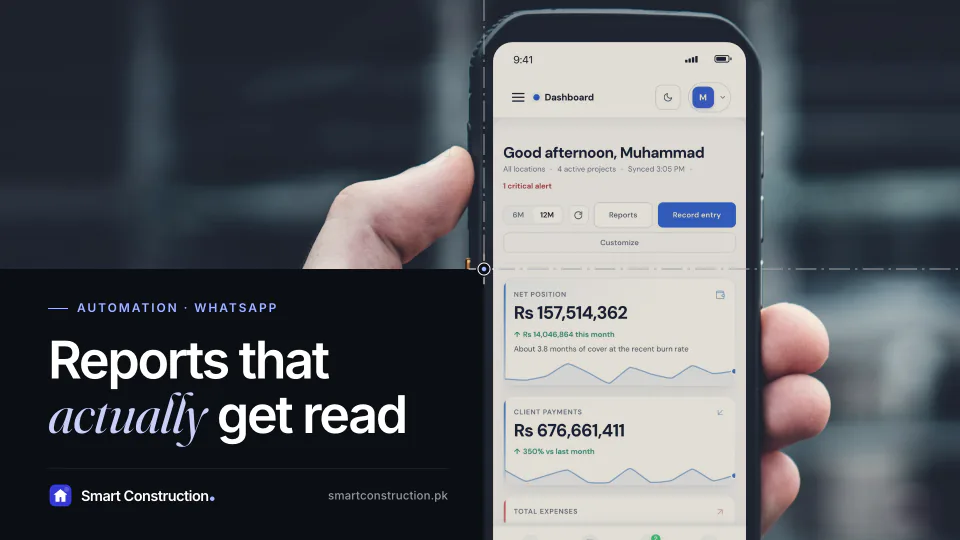
In Pakistan, WhatsApp is where construction actually gets coordinated: owners, site agents, and suppliers all live in the same chat threads. The problem is that updates, bills, and labour numbers get buried, forwarded, and lost. The fix is not to abandon WhatsApp; it is to connect it to your construction management software so the right report reaches the right person automatically.
What WhatsApp automation looks like for contractors
Regular project reports reaching owners and management on WhatsApp, without anyone preparing them
Overdue bills and payments followed up on time, so collections do not slip
Quick answers for directors who need a number, without calling the office
Client and supplier conversations kept with the business, not lost on one person’s phone
Smart Construction includes WhatsApp updates on every plan, and what people read on WhatsApp always matches the figures in the system, so nobody is working from last week’s screenshot.
Why this beats generic construction software in Pakistan
Most international tools assume email-first communication, which does not match how Pakistani site teams work. By making WhatsApp a first-class channel, you cut the daily “please send the update” messages, reduce payment delays, and give owners confidence without giving them full system access.
There is an uncomfortable truth in every construction software rollout: a significant share of the people who need the information will never sign into the system. Directors, owners, clients, and some very capable site staff will simply not open a dashboard, and no amount of training changes it.
You can treat that as a failure of discipline, or you can treat it as a fact and design around it. WhatsApp is where those people already are, several times a day, without being asked.
The four things worth automating
Scheduled reports
A regular summary that reaches the people who need it without anyone sending it. The value is not the report; it is that nobody has to prepare it and therefore it actually arrives every week rather than during quiet months.
Overdue payment reminders
Reminders when a client bill falls overdue. Collection improves less because anyone works harder and more because the routine chasing happens without anyone deciding to do it.
Answers on demand
A director who wants a number at nine on a Sunday evening can ask for it and get it, rather than calling whoever answers. This single change removes a surprising amount of friction from a management relationship.
Conversations that stay with the business
Conversations with clients and suppliers belong to the business, not to one person’s phone. When that person is on leave, or leaves for good, the thread should not disappear with them.
What not to automate
The failure mode of automated messaging is volume. A recipient who gets eleven notifications a day stops reading all of them, including the one that mattered. Alerting has to be scarce to be useful.
Send summaries on a schedule, not events as they happen
Alert on exceptions only: overdue cash, at-risk milestones, deadlines about to pass
Send different things to different roles rather than one message to everyone
Set thresholds deliberately, and review them after a month of real use
Clients and the trust question
Sending a client a progress update they did not have to ask for changes the relationship more than the content of the update warrants. It is a small signal that the project is being run by people who know what is happening, and it arrives before the client has had a chance to worry.
Frequently asked questions
What can Smart Construction send on WhatsApp?
Regular project and management updates for owners and directors, and reminders when client payments fall overdue, so people stay informed without signing in and collections do not slip. Directors can also get a quick answer without calling the office.
Why does WhatsApp matter for construction software?
Because a significant share of the people who need the information, including directors and clients, will never sign into a dashboard. Delivering to a channel they already use daily removes the adoption requirement entirely for that group.
How do we avoid overwhelming people with notifications?
Send scheduled summaries rather than every event, alert only on exceptions, differentiate by role, and review thresholds after a month of real use. A recipient getting eleven messages a day reads none of them.
Can clients receive updates too?
Yes, and unprompted progress updates change a client relationship out of proportion to their content. Clients see how their project is progressing without any access to your commercial records.
Is WhatsApp automation included in every plan?
Yes. WhatsApp updates are part of the full platform on Starter, Growth, and Enterprise. Only active project and user limits change between tiers.
Developers and housing societies need multi-site control, clear accounts for partners and buyers, and PKR billing in one platform. Here is what to look for.