
Commercial11 min read
How to reduce construction cost overruns in Pakistan
Cost overruns rarely come from one big mistake. They accumulate from untracked variations, late procurement, and estimate drift.
Commercial
How Pakistani contractors keep subcontractor contracts, work done, variations, and payments in one clear ledger, so thekedar accounts stop drifting.
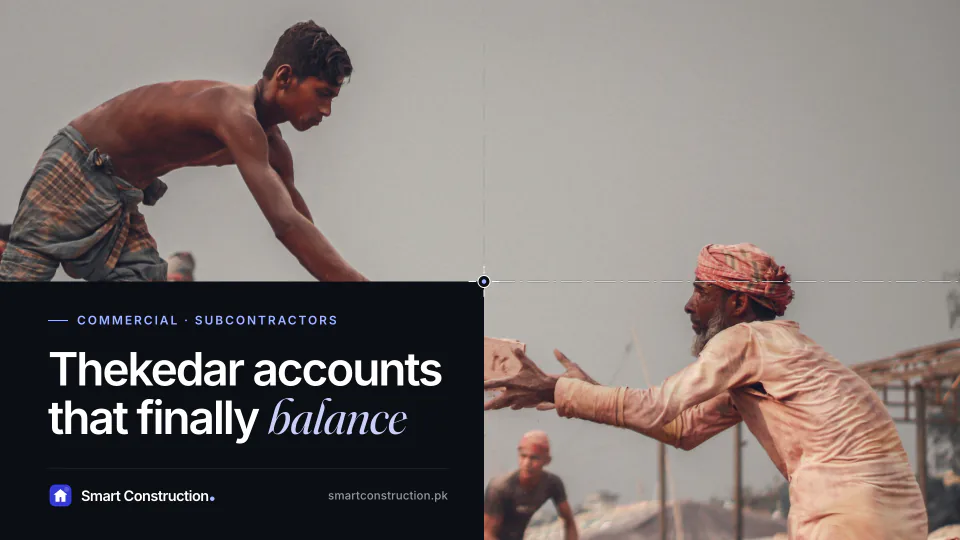
Subcontractor (thekedar) relationships drive margin on most Pakistani builds. Without a dedicated ledger, advance payments, running work, and final settlements are tracked in notebooks that finance cannot audit.
Smart Construction is built for how subcontracting actually runs in Pakistan, so commercial managers know their exposure to each subcontractor before approving the next payment.
A subcontractor account is not one number. It is at least six, moving independently: work certified, payments made, advances outstanding, retention held, back-charges applied, and material issued from your store against their scope. Each is individually simple. The drift comes from the fact that in most companies they are tracked by different people in different places.
So when a subcontractor says they are owed a figure and your office says something different, both are usually right about the part they are tracking. The dispute is not about honesty. It is about the absence of one place where all six components meet.
A ledger that captures four of these will produce a plausible number that is wrong by exactly the two it missed. In practice the two most commonly missed are advances and material issued, which is why the office figure is so often lower than the subcontractor believes and higher than it should be.
Mobilisation advances and interim advances are normal in Pakistani subcontracting and are usually agreed informally, sometimes verbally, often by whoever was on site when the request was made. They are also the amounts most likely to go unrecovered, because recovery depends on somebody remembering at exactly the moment a certificate is being prepared.
The fix is to put every advance on the subcontractor’s account the day it is paid, and to recover it through the certificates that follow rather than at final settlement. Recovery then stops depending on memory, and the amount still outstanding can be stated at any point.
Retention held from subcontractors is money you owe but do not owe yet, and it survives longer than most staff do. On a multi-year contract with a defect-liability period, retention released is often decided by someone who was not involved when it was held. Recording the release event alongside the amount is what makes that handover survivable.
The point about paying subcontractors faster is worth dwelling on. Subcontractors price contractors partly on how difficult they are to get paid by. Being the contractor whose account is always clear is a commercial advantage, not just an administrative one.
Certified work, payments made, advances outstanding, retention held, back-charges, and any material issued from your store against their scope. A ledger missing any of these will produce a confident number that is wrong.
Through the certificates that follow, starting with the next one, rather than at final settlement. Put the advance on the subcontractor’s account the day it is paid, so the amount outstanding is known before each certificate is agreed and recovery stops depending on anyone remembering.
Yes, and this is common. You can see what you owe a subcontractor across every project they work on as well as project by project, so a settlement covers all of them rather than requiring three separate reconciliations.
Record the amount held from each certificate and, when it is released, the event that justified the release. With both on record, the position survives staff changes over a multi-year contract.
Substantially. A dated ledger showing every certificate, payment, advance, and adjustment with the approvals behind them turns a negotiation about who remembers better into a review of a record.
Commercial11 min read
Cost overruns rarely come from one big mistake. They accumulate from untracked variations, late procurement, and estimate drift.

Commercial9 min read
How contractors can keep billing, withholding tax, and FBR-ready records aligned without manual rework.
Commercial11 min read
Why generic accounting tools break on construction, and what job costing, retention, and project P&L should look like in PKR.
Book a walkthrough built around the part of the business this guide is about.
Call +92 333 2466662 during Pakistan business hours.