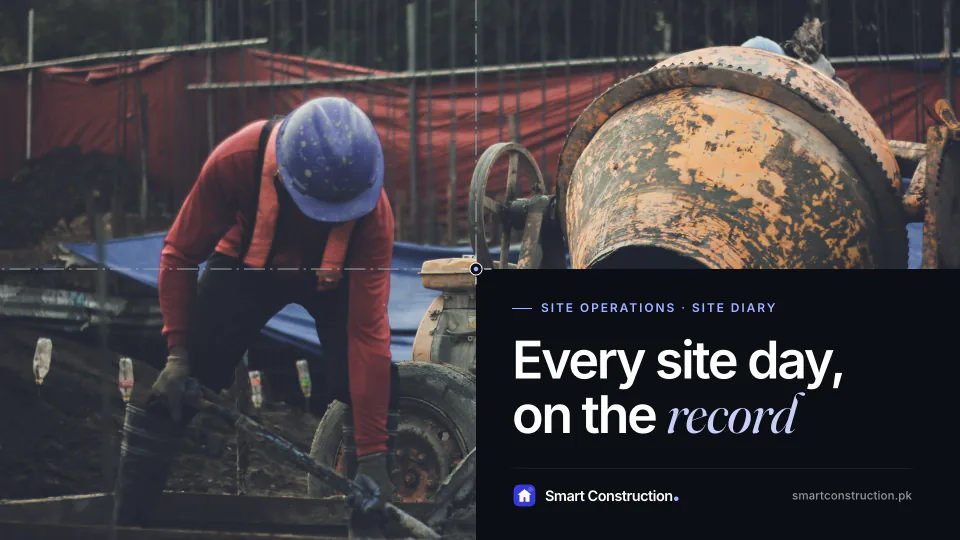
Supervisors write diary notes on paper. Storekeepers update stock in another file. When billing disputes arise, nobody can reconstruct what happened on site that week.
What good site records look like
Daily diary entries with issues and follow-up
Materials in/out linked to the active project
Progress photos tied to milestones
Office teams see the same timeline as site
See how Smart Construction keeps site records and project numbers together, or read our guide on multi-site project control for growing portfolios.
A site diary is insurance you pay for in minutes
Most contractors treat the daily record as administrative overhead until the first time they need it. Then it becomes the most valuable document in the business, and its absence becomes the most expensive one.
The situations are predictable. A client claims a delay was your fault. A consultant questions what was poured on a particular date. A subcontractor claims they were denied access for three weeks. In each case the question is the same: what does the contemporaneous record say? If the answer is that there is no contemporaneous record, the argument is decided by whoever is more persuasive, and that is usually the party with more lawyers.
What a diary entry has to contain
Work completed, by package, so progress claims have something behind them
Crews and resources present, which is what supports a disruption claim
Materials consumed, which is what makes stock reconcile
Equipment on site, which is what makes a hire invoice checkable
Weather and site conditions, which is what supports an extension claim
Anything that stopped work, with a coded reason rather than free text
Coded reasons matter more than they sound. Free text is unsearchable, so a year of diary entries recording delays as prose tells you nothing about patterns. Coded reasons let you see that a particular subcontractor caused nine access delays across three projects, which is a commercial fact rather than an impression.
Materials: the three-way comparison
Material variance is invisible unless you can compare three things: what was purchased, what was consumed, and what the completed work should have required. Contractors who only count stock periodically can see the first and a snapshot of what remains, which is not enough to identify a problem while it is still small.
Goods received, recorded against the purchase order that ordered them
Issues from the store, coded to the work that consumed them
Transfers between sites, recorded at both ends
Returns to supplier, credited against what you owe them
With those four movements captured, the comparison against progress becomes possible, and a gap surfaces in weeks rather than at a year-end count when it is far too old to trace.
Photos that can be found again
Every site takes photographs. Almost no site can retrieve the right one when it matters, because they live in a camera roll organised by date and nothing else. A photo attached to a project, a package, and a milestone can be retrieved by what it evidences, which is the only way anyone ever wants to search for it.
Making the record survive the person
The most experienced supervisor on your largest site probably keeps most of it in his head, and does so competently. That is fine until he takes leave, and it is a genuine business risk when he resigns. A structured daily record does not replace that experience. It just means the site does not go dark when the person does.
Frequently asked questions
What should a construction site diary include?
Work completed by package, crews and resources present, materials consumed, equipment on site, weather and site conditions, and coded reasons for anything that stopped work. Photos should attach to the entry that describes them.
Why use coded delay reasons instead of free text?
Free text is unsearchable, so a year of entries tells you nothing about patterns. Coded reasons reveal that a particular cause recurs across projects, which turns an impression into a commercial fact you can act on.
How does a site diary help with a delay claim?
It provides contemporaneous evidence of what happened, when, and why. In an extension-of-time discussion months or years later, a dated record made at the time carries far more weight than any reconstruction.
How do we reconcile material consumption?
Record goods received against the purchase order, issues against the work that consumed them, transfers between sites, and returns to supplier. Consumption can then be compared against purchase and against completed work.
Will supervisors actually complete a daily entry?
Only if it is short and available on the phone they already carry. A comprehensive form will be abandoned within weeks; a few-minute entry recorded daily is what survives, and it is what a claim depends on.
Developers and housing societies need multi-site control, clear accounts for partners and buyers, and PKR billing in one platform. Here is what to look for.