Projects10 min read
Multi-site construction project control in Pakistan
Portfolio dashboards, milestones, and role-based access when you run more than one active site.
Projects
Growing contractors fail on visibility across sites, not on a single job. A practical model for multi-site control.
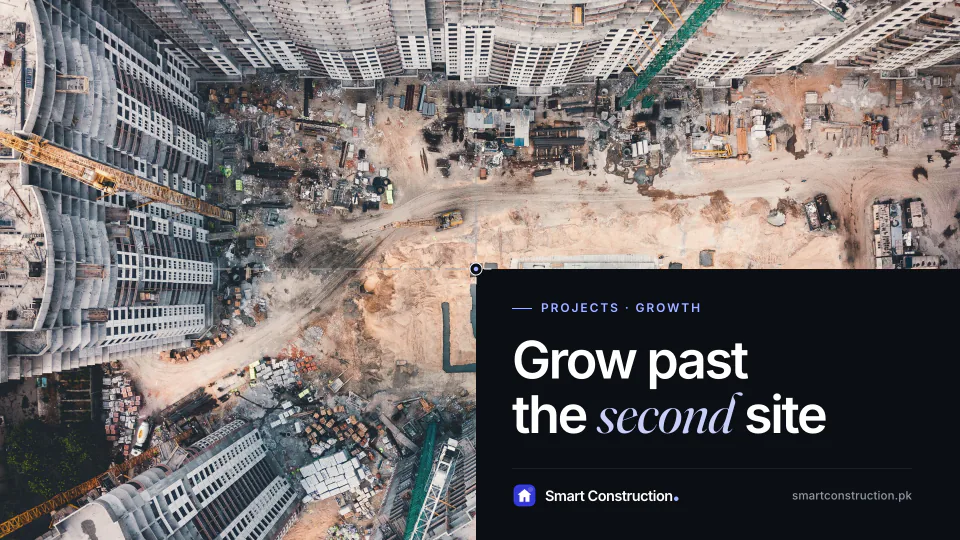
A contractor running one site can hold everything in their head. At five or fifteen sites, that breaks. Each site invents its own spreadsheet for progress, procurement, and cash, and leadership only learns about problems after they cost money.
When every site follows the same model, comparing them becomes trivial. You can see which job is behind schedule, which is burning cash, and which subcontractor is overexposed without calling each site engineer.
The biggest multi-site time sink is re-entering data. Capture attendance, site diary, and material movement once on site, and let payroll, cost, and reports reuse it. Double entry is where multi-site control quietly falls apart.
Smart Construction is built for multi-site portfolios: projects, users, and permissions scale from Starter through Enterprise. See multi-site project management, or book a demo.
Most contractors who grow from two sites to five do it by adding head-office people. A coordinator here, an assistant there, someone to chase the site reports. It works, and it is also the reason margin does not improve with scale: the additional people are almost entirely doing reconciliation between systems that do not talk to each other.
The alternative is to standardise before you scale, so the fifth project inherits governance rather than negotiating it. That costs discipline at the third project and pays from the fourth onwards.
It is worth being specific about why multi-site is harder than single-site, because it is not simply arithmetic. The difficulty comes from sharing.
Every one of those is solved the same way: code the transaction to a project at the moment it happens, rather than splitting it afterwards. Splitting afterwards is where accuracy is lost, and it is also where the head-office coordinator’s time goes.
On a single site, a supervisor reporting by phone is efficient. On five sites it is five phone calls a day to whoever is available, each producing a different level of detail, none of it recorded.
A short structured daily entry per site replaces all of it, and crucially it is written once by the person who knows, rather than three times by people who are relaying. The office reads five entries in the time it previously spent on one call.
The end state worth aiming for is a weekly review that starts from an exception list rather than a status recital. Every project reports the same measures, so the meeting opens with the two that need a decision instead of working through all five in order.
Nothing on that list requires preparation if the underlying records are being kept. That is the point of the whole exercise.
Record goods received against the purchase order, code issues to the project and work that consumed them, and record transfers between sites. Each project then carries its true material cost without anyone splitting a total afterwards.
Record attendance per worker per day against whichever project they actually worked. Labour cost then lands correctly even when a crew works three sites in a fortnight.
Generally yes. Decide once who can approve what, for the whole company, and hold every project to it. Per-project negotiation produces arrangements that are remembered rather than enforced.
Daily, and briefly. Cadence matters more than depth: a short entry completed every day is worth more than a comprehensive one completed when someone chases it.
Only if growth is absorbed by reconciliation. When every site follows the same rules and every transaction is recorded against a project as it happens, a new site costs a setup rather than another coordinator.
Projects10 min read
Portfolio dashboards, milestones, and role-based access when you run more than one active site.

Guides10 min read
Developers and housing societies need multi-site control, clear accounts for partners and buyers, and PKR billing in one platform. Here is what to look for.
Automation9 min read
A practical look at AI for Pakistani contractors: an assistant that answers questions about your projects and writes summaries, instead of buzzwords.
Book a walkthrough built around the part of the business this guide is about.
Call +92 333 2466662 during Pakistan business hours.